
Chair of Human-Centered Technologies for Learning
Research Clusters
AI for Empowerment and Learning
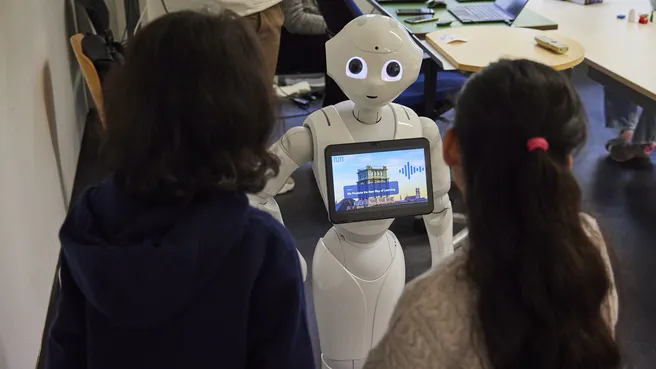
Focus: Developing AI systems that amplify human learning, creativity, and agency through collaborative human-AI partnerships.
Technologies: Artificial Intelligence (AI), machine learning, natural language processing, generative models.
Immersive Environments for Human Augmentation
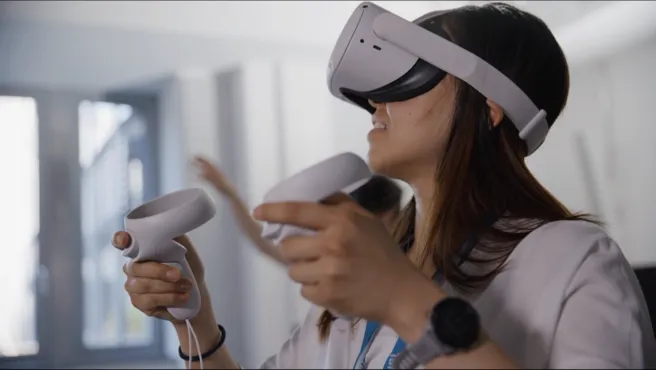
Focus: Advancing human perception, collaboration, and innovation through immersive technologies.
Technologies: Virtual Reality (VR), Augmented Reality (AR), Mixed Reality (MR), spatial computing.
Our research pioneers human-centered AI that transforms how individuals learn, create, and thrive. By fostering collaborative partnerships between humans and AI, we enhance educational experiences, spark innovative thinking, and promote agency in domains like professional development, social interaction, and lifelong learning.
We create immersive environments that augment human perception and capabilities, empowering users to explore virtual worlds, design innovative solutions, or collaborate in enhanced realities. By integrating human-centered AI, these systems adapt to user needs, enabling applications in fields like education, training, entertainment, and social interaction.
Multimodal and Adaptive Systems for Empowered Interaction
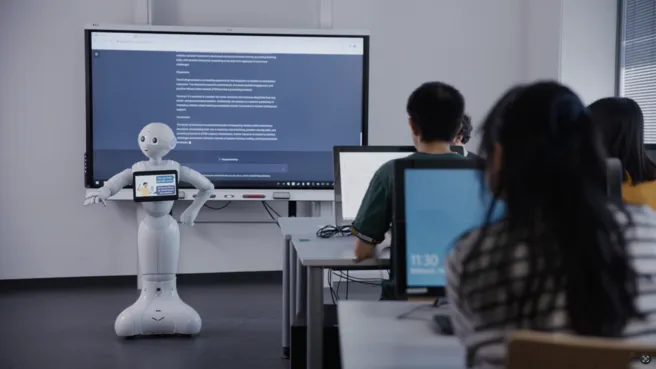
Focus: Enabling intuitive, personalized, and inclusive human-technology interaction through dynamic, multi-sensory systems.
Technologies: AI, VR, AR, eye-tracking, multimodal sensing.
Eye Tracking and Gaze-Based Interaction

Focus: Harnessing eye-tracking to enhance human attention, intent, and social connection in interactive systems.
Technologies: Eye-tracking, AI, multimodal sensing, VR/AR integration.
We develop multimodal and adaptive systems that empower users by making technology responsive, intuitive, and tailored to individual needs. By combining multi-sensory interfaces with human-centered AI, these systems support seamless interaction for creative expression, professional workflows, and inclusive applications, ensuring accessibility for diverse users across contexts like collaboration, productivity, and innovation.
Our gaze-based research augments cognitive and social capabilities by using eye-tracking to capture user intent and enhance interaction. Integrated with human-centered AI, these systems empower users in real-time collaboration, creative design, and inclusive communication, with applications spanning education, healthcare, gaming, and professional environments, ensuring accessibility and engagement for all.
News
New Paper at ITET 2026
Wunmin Jang, Hong Gao, Tilman Michaeli, and Enkelejda Kasneci examine visual attention and communication patterns in distributed pair programming and what they mean for programming education. The paper was presented at ITET 2026 in Hiroshima, Japan, where it received the Best Presentation Award.
Between Hype and Reality - Interview with Prof. Kasneci

AI is reshaping education. But are we asking the right questions? The latest issue of didacta Magazin features an interview with Prof. Enkelejda Kasneci by Roman Eisner on exactly that. The interview tackles the tensions that matter most right now: How do we use AI in classrooms without students skipping the skills they still need to build? How do we stop a digital divide from widening between those who have access and those who don't? And how do we actually prepare teachers for a technology that is moving faster than our research base? The conclusion? Read the full interview to find out.
Best Presentation Award at the ITET 2026

Wunmin Jang from our research group received the Best Presentation Award at the 2026 7th International Conference on Information Technology and Education Technology (ITET 2026), held in Hiroshima, Japan, on June 5-7, 2026. The award recognized the work titled "Understanding Visual Attention and Communication in Distributed Programming for Programming Education." The presentation was delivered in the conference session "Educational Technology Tools: Design, Interaction, and Learning Outcomes." Co-organized with IEEE, the conference brought together current research in the field of educational technology.
Mengdi Wang Successfully Defends Doctoral Thesis

His research focused on preserving eye privacy in extended reality through local machine learning pipelines.
He approached his research goal from two directions.In the first research direction, he developed privacy-preserving eye image processing methods that balance image quality, utility, privacy preservation, and malicious-use risk.In the second research direction, he developed novel federated learning and split learning methods that improve convergence and performance without additional communication or computation overhead.
New Paper in AI and Ethics: The Hidden Safety Failures of Modern AI Systems
AI safety research has long focused on visible failures. Shocking outputs, policy violations, adversarial examples. A new paper in AI and Ethics by Prof. Dr. Gjergji Kasneci and Prof. Dr. Enkelejda Kasneci makes the case that the more consequential failures are elsewhere and offers a framework for finding them. The question is no longer whether AI systems make mistakes. It is whether we are still able to notice them.
Kasneci, G., Kasneci, E. The safety failures we are not instrumenting: a perspective on hidden safety-critical challenges in modern AI systems. AI Ethics 6, 295 (2026).