
Paper Accepted at AIED 2026
We are happy to announce that our paper has been accepted at the International Conference on Artificial Intelligence in Education (AIED) 2026, taking place in Seoul, South Korea.
Should AI Ask First? Investigating the Effects of Proactive vs Reactive AI Mentoring in Self-Directed Learning - Khaoula Otmani, Anna Bodonhelyi, Babette Bühler, Enkelejda Kasneci
Congratulations to all authors!
10 Papers Accepted at ETRA 2026
We are excited to announce that our group has 10 papers accepted at the ACM Symposium on Eye Tracking Research & Applications (ETRA) 2026, taking place June 1–4 in Marrakesh, Morocco.
Our contributions span four full papers, one short paper, and five workshop papers, covering topics from LLM-based eye-tracking event detection and privacy-preserving scanpath comparison to misinformation susceptibility and affordable wearable eye-tracking platforms.
Congratulations to all authors!
ACL 2026 Paper Accepted
From Scoring to Explanations: Evaluating SHAP and LLM Rationales for Rubric-based Teaching Quality Assessment
This paper introduces a general framework for generating and evaluating sentence-level explanations in rubric-based teaching quality assessment by combining SHAP attributions with LLM-generated rationales. Experiments on classroom transcripts show that while fine-tuned language models outperform LLMs in scoring accuracy, SHAP provides significantly more faithful and transferable explanations than LLM rationales, which are often inconsistent and weakly aligned with model predictions. Overall, the work highlights the limitations of current LLM explanations and offers a principled approach to improving transparency in high-stakes educational assessment settings.
Journal Paper Accepted in Computers & Education: AI
With generative AI (GenAI) becoming increasingly prevalent in higher education, concerns about overreliance and declining critical engagement highlight the need to better understand learning-to-learn as a lifelong learning skill and how it can be supported. Based on a PRISMA-ScR scoping review, the paper synthesizes existing definitions into a three-layered framework that can help clarify the concept across levels of broadness. Connecting the framework to emerging GenAI research, it offers a structured starting point for developing pedagogically grounded AI-supported learning practices and systems, reframing GenAI from a potential source of cognitive offloading into a tool that can support effective learning processes.
DOI: https://doi.org/10.1016/j.caeai.2026.100575
06.03.2025: Paper Acceptances at CHI'26!

We are thrilled to share that Carrie Lau, a doctoral researcher in our group, will be presenting her paper at CHI 2026 - the ACM Conference on Human Factors in Computing Systems. Her paper explores how the appearance of AI avatars influences job applicants' perceptions of trust, fairness, and bias in AI-conducted interviews, offering design insights for more equitable AI hiring systems. The paper has also received a CHI 2026 Honourable Mention Award, recognizing its originality, rigor, and potential impact in the field of human–computer interaction. Congratulations to Carrie and other co-authors for their outstanding contributions!
Read More: Skin-Deep Bias: How Avatar Appearances Shape Perceptions of AI Hiring
20.02.2026: Philipp Hallgarten Successfully Defends Doctoral Thesis

Philipp Hallgarten has successfully defended his doctoral thesis and completed his PhD at the Technical University of Munich in cooperation with Porsche Human-Centered AI Research.
His research focused on using context information to build intelligent in-vehicle systems that understand driving situations and adjust their behavior accordingly.
Among others, he presented the first Large Language Model that can understand driving context on a token level, and a system that can detect memorable moments during a car ride purely from driving context.
AAAI 2026 Paper Accepted
This paper presents a large-scale, year-long analysis of over 23,000 real-world interactions with an open-access AI writing feedback system. The results show that students who revise their texts based on AI feedback achieve modest but significant improvements in writing quality, with the strongest gains among initially lower-performing writers. The study highlights both the potential of generative AI for scalable educational support and the challenges of ensuring equitable engagement.
Authors: Babette Bühler, Ivo Bueno, Enkelejda Kasneci
Read the paper: https://lnkd.in/dZpGGSyF
25.11.2025: Insights from the relAI Symposium 2025
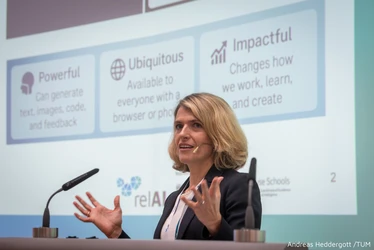
The relAI Symposium 2025, organized by the Konrad Zuse School of Excellence in Reliable AI, brought together leading researchers, industry experts, and policymakers to discuss the responsible transformation driven by generative AI.
During the event, Enkelejda Kasneci from the Technical University of Munich** presented the new research focus area “Learning & Instruction,” highlighting innovative approaches at the intersection of AI and education. The symposium emphasized the importance of trustworthy, human-centered AI for science, industry, and society.
10–11 November 2025 - Participation in the Panel “Challenges for Teaching – Artifical Intelligence (AI) in Academic Education”

On 10–11 November 2025, Enkelejda Kasneci participated in the XVIII. Hochschulsymposium “KI in der Wissenschaft – Wie gestalten wir die Universitäten neu?” at the Hanns Martin Schleyer-Stiftung in Munich. Enkelejda Kasneci joined the panel on AI in academic education, discussing academic integrity, AI literacy, new teaching formats, and institutional strategies together with experts from the Harvard Graduate School of Education and University College London.
Full Panel Discussion More Information: XVIII. Hochschulsymposium, TUM Schleyer-Stiftung Feature Image by Hanns Martin Schleyer-Stiftung
07.11.2025: Our Team Wins Second Place in the AIAI Competition
We are pleased to announce that our team — Ivo Bueno, Ruikun Hou, Dr. Babette Bühler, and Dr. Tim Fütterer — has won second place in the AI for Advancing Instruction (AIAI) Competition 2025, organized by DrivenData in collaboration with the University of Virginia.
The AIAI challenge invited participants to develop machine learning models capable of automatically identifying instructional activities in classroom videos and discourse content in anonymized audio transcripts.
Our submission focused on transformer-based architectures optimized for multimodal data, achieving excellent performance across both video and audio tasks. The competition comprised two phases—model development on labeled training data and evaluation on an unseen test set—with final rankings determined by the instructional activity and discourse labels predictions.
This competition brought together leading research teams from around the world, advancing the state of the art in AI-assisted education research.
We warmly congratulate Ivo, Ruikun, Babette, and Tim on this remarkable achievement, and extend our thanks to the competition organizers and all participating teams for their inspiring contributions to this important field.
21.10.2025 - Women in Data Science Worldwide
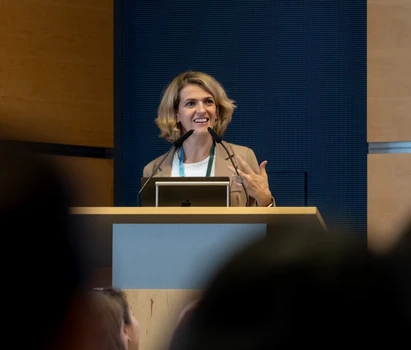
Women in Data Science (WiDS) Munich is a regional one-day event organized by the Ludwig-Maximilians-University Munich (LMU), the Technical University Munich (TUM) , Bayerischer Rundfunk (BR), Pruna AI, and Sixt, associated with the WiDS worldwide non-profit organization.
Women in Data Science Worldwide - Munich Conference
Zugang Gestalten Conference, Leipzig
Mehr Informationen
Carrie Lau was invited by the German Commission for UNESCO to speak at the Zugang Gestalten Conference, held at the Deutsche Nationalbibliothek in Leipzig. Her talk explored how Virtual Reality (VR) and Generative AI can democratize access to cultural heritage. 🔗 Watch the talk on YouTube
31.08 – 03.09.2025: Route2Vec Earns Honorable Mention at MuC 2025 in Chemnitz

We are pleased to announce that Philipp Hallgarten has received an Honorable Mention at Mensch und Computer (MuC) 2025 held in Chemnitz, Germany, for the paper “Route2Vec: Enabling Efficient Use of Driving Context through Contextualized Route Representations.”
The paper presents Route2Vec, an attention-based self-supervised framework that encodes contextual data from driving routes into compact embeddings and thus enables the design of context-aware in-vehicle interfaces.
Paper DOI: https://doi.org/10.1145/3743049.3743056
28.08.2025: Babette Bühler Wins FUTURE EDUCATION Early Career Award
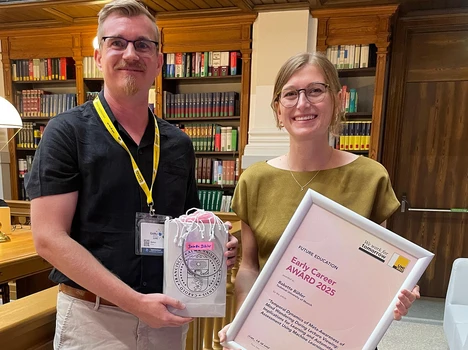
We are proud to announce that our postdoctoral researcher, Dr. Babette Bühler, has been awarded the FUTURE EDUCATION Early Career Award 2025 in the category Educational Technology(ies): interdisciplinary, innovative, disruptive.
She received the award for her paper: “Temporal Dynamics of Meta-Awareness of Mind Wandering During Lecture Viewing: Implications for Learning and Automated Assessment Using Machine Learning.” https://doi.org/10.1037/edu0000903
The award was presented on 28 August 2025 at the EARLI Conference at the University of Graz. This year marked the secon edition of the FUTURE EDUCATION Early Career Awards, which celebrate excellent transdisciplinary research in education, learning, development, and teaching. Awardees were selected through a rigorous single-blind peer review process, with submissions evaluated by both FUTURE EDUCATION network reviewers and EARLI community experts.
We warmly congratulate Babette on this well-deserved recognition!
22.07.2025: Papers Accepted at ICMI 2025 and ECAI 2025
We are pleased to announce that our group has had two full papers and one doctoral consortium paper accepted at the International Conference on Multimodal Interaction (ICMI 2025), and one paper accepted at the European Conference on Artificial Intelligence (ECAI 2025).
ICMI 2025:
- "Multimodal Behavioral Patterns Analysis with Eye-Tracking and LLM-Based Reasoning"
- “Adaptive Gen-AI Guidance in Virtual Reality: A Multimodal Exploration of Engagement in Neapolitan Pizza-Making”
- Designing and Evaluating Gen-AI for Cultural Resilience (Doctoral Consortium Track)
ECAI 2025:
- "TRUCE-AV: A Multimodal Dataset for Trust and Comfort Estimation in Autonomous Vehicles"
17.06.2025: Prof. Enkelejda Kasneci Gave a Keynote Speech at IS-EUD 2025

Professor Enkelejda Kasneci gave a keynote speech at the International Symposium on End-User Development (IS-EUD) 2025. “Can Learners Design Their Future? Promoting Agency with Large Language Models in Education”
More information is available on the IS-EUD 2025 Keynote Speakers page.
09.06.2025: Prof. Enkelejda Kasneci Delivered Invited Lecture at University of Tokyo

Professor Enkelejda Kasneci delivered an invited lecture titled “Augmenting Human Potential through Human-Centered AI and Attention-Aware Systems” at the University of Tokyo’s Institute of Industrial Science, hosted by the Interactive Visual Intelligence Lab under the leadership of Professor Yusuke Sugano.
28.05.2025: Best Paper Honorable Mention at ETRA 2025

We are thrilled to announce that Virmarie Maquiling, doctoral researcher at the Chair of Human-Centered Technologies for Learning, has received a Best Paper Honorable Mention at the ACM Symposium on Eye Tracking Research & Applications (ETRA 2025) held in Tokyo, Japan.
Her paper, which explores imperceptible gaze guidance in virtual reality, was recognized for its innovative contribution to the field of user-centered eye-tracking research.
Congratulations on this well-deserved honor!
Paper DOI: https://doi.org/10.1145/3725839
15.04.2025: Paper Acceptances at ETRA and DSP!
We are thrilled to share that four papers from our group have been accepted to the ACM Symposium on Eye Tracking Research & Applications (ETRA) and three papers have been accepted to the International Conference on Digital Signal Processing (DSP) this year.
Congratulations to all the authors for their outstanding contributions!
12.03.2025: Supporting socially disadvantaged children with AI

The pioneering educational project initiated by the Roland Berger Foundation and the Technical University of Munich (TUM) aims to impart artificial intelligence (AI) skills to socially disadvantaged children. Within this project, children start learning to use AI responsibly and critically from as early as third grade.
Under the scientific leadership of Prof. Enkelejda Kasneci, director of the TUM Center for Educational Technologies, the three-year model focuses on AI literacy and enhancing writing and language skills through AI-supported tools.
The project also collaborates with 70 partner schools, supporting 650 talented children. Guided by Prof. Kasneci, the initiative aims to fully develop the individual potential of these children, opening up future opportunities for them because by 2035, there will no longer be a job in Germany without AI.
04.03.2025: Professor Enkelejda Kasneci Delivered Keynote at WACV 2025
Our professor, Enkelejda Kasneci, delivered a keynote address at the IEEE/CVF Winter Conference on Applications of Computer Vision (WACV 2025) on March 4, 2025.
WACV is a premier international conference dedicated to advancing computer vision applications, featuring a diverse program that includes the main conference, workshops, and tutorials.
For more details on WACV 2025 and the complete conference schedule, please visit the official website.
06.12.2024: Heinz Maier-Leibnitz Medal for Enkelejda Kasneci and Tina Seidel

At TUM's Dies Academicus, Professors Enkelejda Kasneci and Tina Seidel were honored with TUM's highest scientific award, the Heinz Maier-Leibnitz Medal. Vice President Prof. Gerhard Kramer attributed this to establishing the TUM Center for Educational Technologies (EdTech Center). The psychologist and the computer scientist are jointly researching the use of AI in teaching and learning. Their newly developed tools have now been used by over 100,000 people.
30.10.2024: Young Minds Explore AI at TUM Workshop
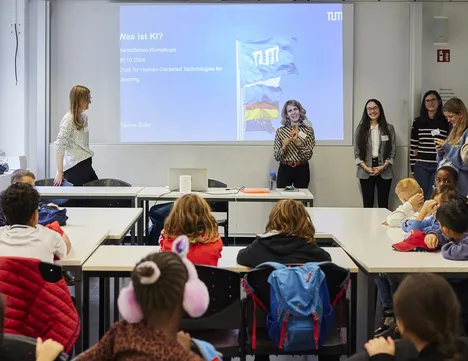
In a three-day seminar (28-30 October 2024) at the Technical University of Munich (TUM), nearly 30 third-grade students from the "Münchner Kindl" scholarship program explored the fundamentals of artificial intelligence (AI) through interactive and playful methods. They used AI model tools like Teachable Machine, robot Pepper, and VR Glasses. Professor Enkelejda Kasneci led the seminar in collaboration with TUM and the Roland Berger Foundation.
High School Students Experience EyeTracking Technology
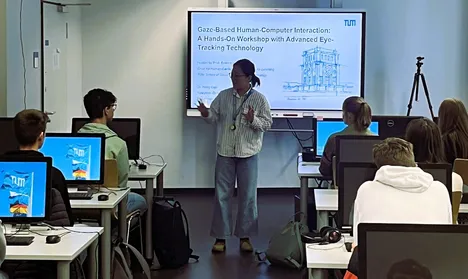
On September 18, 2024, we hosted an informative seminar on EyeTracking technology. The session provided deep insights into how EyeTracking enhances scientific research. A highlight of the event was the hands-on demonstration, where around 20 high school students had the opportunity to experience the technology firsthand and ask questions about its applications.
Workshop with Roland Berger Foundation Scholars
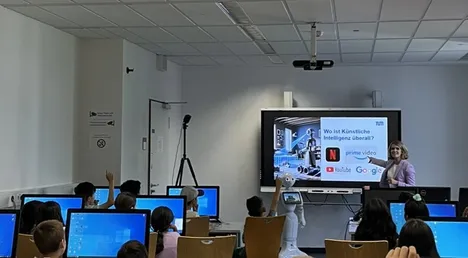
On July 5, we were excited to welcome about 30 Roland Berger Foundation scholars to an artificial intelligence workshop. The kids had a great time diving into the world of AI, learning about its basics and real-world uses through fun activities and lively discussions. Our goal was to spark their interest and show them the incredible possibilities AI offers.
Freunde der TUM e.V Event - EdTech
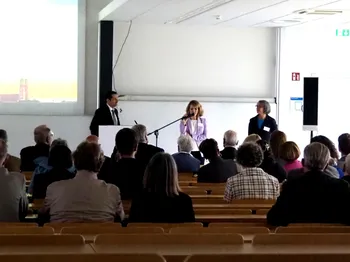
On June 11, 2024, Prof. Dr. Enkelejda Kasneci and Prof. Dr. Tina Seidel delivered speeches at an event organized for the friends of TUM e.V. The event was further enriched by the esteemed presence of Prof. Dr. Thomas F. Hofmann, President of the Technical University of Munich, who also delivered a speech. After their presentations, attendees were given the unique opportunity to interact with and learn about the latest advancements in educational technologies.
ETRA 2024 Award: Best Late Breaking Work
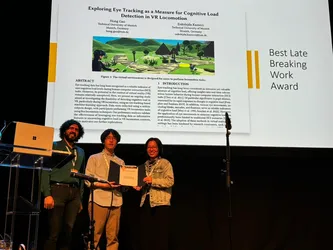
Hong Gao and Enkelejda Kasneci received the Best Late Breaking Work Award at the Eye Tracking Research & Applications (ETRA) 2024 conference.
Their paper titled “Exploring Eye Tracking as a Measure for Cognitive Load Detection in VR Locomotion” received the award.
Paper DOI:
08 June 2024: Xplorer Day

The first Xplorer Day focuses on integrating Artificial Intelligence (AI) and Extended Reality (XR) into education, emphasizing their role in transforming learning and teaching methods. It highlights the importance of educators in harnessing these technologies to inspire and equip students with the skills to navigate a digital world.
Our colleagues Enkeleda Thaqi and Carrie Lau will be part of the event.
Click here to see details about the event and our projects.
TUM Open Campus March 2024 - Human Centered Technologies for Learning
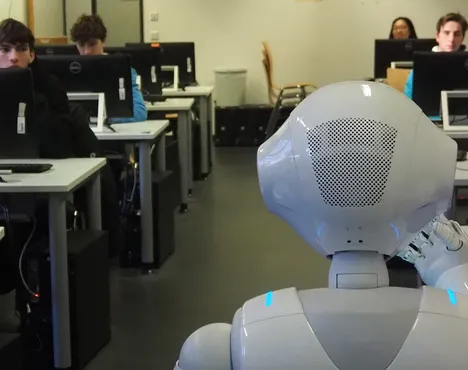
Recent TUM Open Campus event, we are thrilled to share highlights from this enriching experience. Our campus became a vibrant hub of discovery and learning, welcoming prospective students and enthusiasts alike.
TechBoost Deutschland Summit
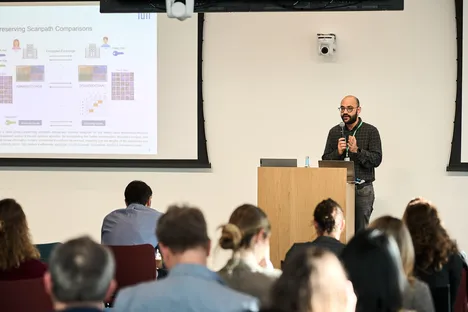
Our team was thrilled to attend the TechBoost Summit in Munich, an event at the intersection of technology and education. The summit was a showcase for forward-thinking discussions highlighting the evolution of learning, immersive technologies, and the implications of the technologies on education. It offered a unique opportunity to connect with industry leaders and absorb insights on leveraging technology to advance educational practices.
Panel: Kann KI Kreativ Sein?
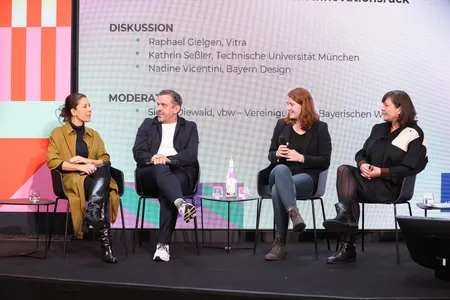
Kathrin Seßler war Teil der Medientagen München (#MTM23), bei der Podiumsdiskussion zum Thema "Kann KI kreativ sein?“.
ECTEL 2023: Our paper won the “Best Demonstration” Award:
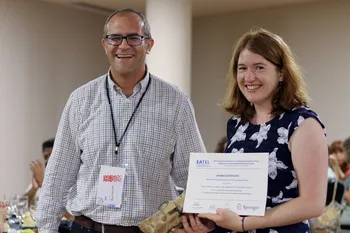
We are thrilled to announce that our paper has received the "Best Demonstration" Award at the European Conference on Technology Enhanced Learning (ECTEL) 2023 in Aveiro, Portugal. Check out our paper PEER: Empowering Writing with Large Language Models
Generative KI für alle?

Prof. Enkelejda Kasneci in der globale Diskursreihen „One Topic, One Loop“
»In der Bildungswissenschaft bergen diese Technologien großes Potenzial für die Entwicklung adaptiver, kooperativer und immersiver Lernumgebungen, die auf den einzelnen Lernenden zugeschnitten sind.«
Interview: How the Chatbot Is Revolutionizing School
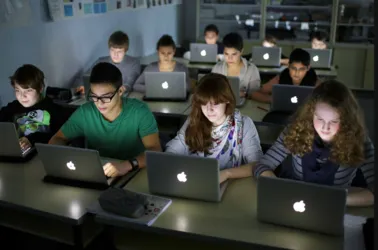
An interview with Enkelejda Kasneci, handelsblatt.com.
ChatGPT in the classroom:
AI in the classroom? Germany is mainly discussing the risks. Other countries are further ahead and are already working on a revolution in traditional teaching.
Interview: AI Assistants Are Definitely Disrupting Education
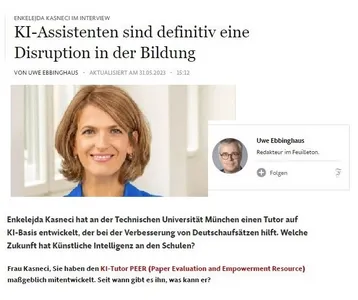
Enkelejda Kasneci in an interview:
Enkelejda Kasneci has developed an AI-based tutor at the Technical University of Munich that helps improve German essays. What future does artificial intelligence have in schools?
Rotary Magazine Article: More Opportunities Than Risks
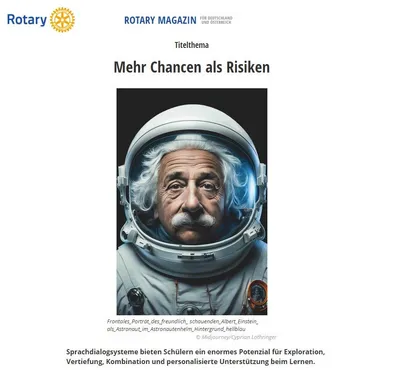
Speech dialogue systems offer students enormous potential for exploration, deepening, combination and personalized support in learning.
Kann ChatGPT Schule ersetzen?
Mehr Informationen
Prof. Enkelejda Kasneci im Interview mit BR24
»ChatGPT ist ein Automatisierungstool, das aus sehr vielen Daten gelernt hat. Ich stehe dazu sehr positiv, es wird in der Bildung ein Gamechanger sein. Wir müssen uns diese Lösung genau anschauen.«
ChatGPT an Schulen und Hochschulen: Welchen Platz hat KI in Unterricht und Lehre?
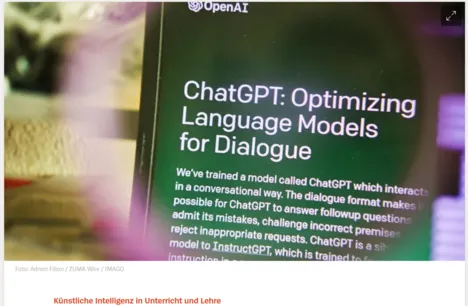
Prof. Enkelejda Kasneci im Interview mit dem SPIEGEL
»Ich bin davon überzeugt, dass KI-Sprachmodelle wie ChatGPT ein wichtiger technologischer Meilenstein sind. Sie haben das Potenzial, die Art und Weise zu revolutionieren, wie wir lernen und lehren.«
ChatGPT kann zu mehr Bildungsgerechtigkeit führen
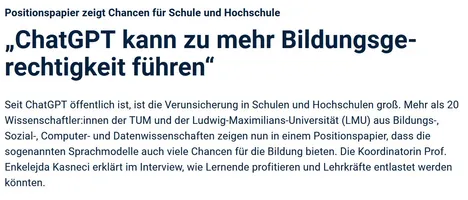
Prof. Enkelejda Kasneci im Interview mit der TUM
»Die Entwicklung von Sprachmodellen wie ChatGPT ist ein technologischer Meilenstein, ein Zurück wird es nicht geben. Die Tools sind in der Welt, sie werden besser werden und wir müssen lernen, sie konstruktiv zu nutzen.«
Wie ChatGPT Schule und Lernen verändern könnte
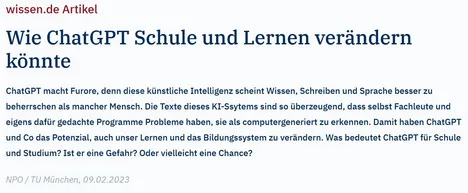
Prof. Enkelejda Kasneci im Interview
»Hier sehen wir ein großes Potenzial, mit dem personalisierten Einsatz solcher Tools die individuellen Schwächen jedes einzelnen Kindes zu entschärfen, die Stärken hervorzuheben und zu einem konstruktiven Lernerfolg beizutragen.«