
Ivo Bueno
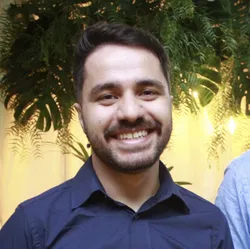
Research Assistant, PhD Student
Room: 249
Office Hours: by Appointment
E-Mail: ivo.bueno[at]tum[dot]de
🧑💻 About Me
I am a passionate Ph.D. candidate at the Technical University of Munich. My academic journey began with a Bachelor's degree in Computer Science from FAU Erlangen-Nürnberg, followed by a Master's in Computational Linguistics from LMU Munich. My research interests lie at the intersection of machine learning, natural language processing, and multimodal AI, with a strong focus on fostering effective and ethical interactions between humans and intelligent systems.
Before starting my Ph.D., I gained over five years of experience as a software developer at e.solutions GmbH, working on real-world applications in industry. During my Master's, I further honed my expertise as a research assistant, designing and teaching programming tutorials while supporting exam development. Now, in my Ph.D., I am excited to explore novel approaches to human-centered AI, combining insights from computational linguistics, federated learning, and privacy-enhancing technologies to create more inclusive and intelligent learning systems.
📈Career Development
- 2019 – 2022: B. Sc. in Computer Science, FAU Erlangen, Germany
- 2022 – 2024: M. Sc. in Computational Linguistics, LMU Munich, Germany
- 2025 – Present: Doctoral candidate, TU Munich, Germany
🧠Research Interest
- Machine Learning / Deep Learning
- Natural Language Processing
- AI for Education
- Interpretability
📚Publications
- Bueno, I., Hirlimann, L., and Kasneci, E. (2026, April). MemeScouts@LT-EDI 2026: Asking the Right Questions -- Prompted Weak Supervision for Meme Hate Speech Detection. arXiv preprint arXiv:2604.24179. Accepted at the Sixth Workshop on Language Technology for Equality, Diversity and Inclusion (LT-EDI@ACL 2026).
- Bueno, I., Hou, R., Bühler, B., Fütterer, T., Drimalla, J., Foster, J. K., … Kasneci, E. (2026, March). Exploring Automated Recognition of Instructional Activity and Discourse from Multimodal Classroom Data. Proceedings of the IEEE/CVF Winter Conference on Applications of Computer Vision (WACV), 6806–6817.
- Bühler, B., Bueno, I., & Kasneci, E. (2026, March). Democratizing Writing Support with AI: Insights from One Year of Real-World Interactions with an Open-Access Writing Feedback Tool. Proceedings of the AAAI Conference on Artificial Intelligence, 40(45), 38278-38286. doi:10.1609/aaai.v40i45.41167
- Bueno, I., Bavaresco, A., Cunha, J. M., & Wicke, P. (2025, August). Testing Spatial Intuitions of Humans and Large Language and Multimodal Models in Analogies. In G. Rambelli, F. Ilievski, M. Bolognesi, & P. Sommerauer (Eds), Proceedings of the 2nd Workshop on Analogical Abstraction in Cognition, Perception, and Language (Analogy-Angle II) (pp. 108–132). doi:10.18653/v1/2025.analogyangle-1.9
- de Souza Bueno Júnior, I., Ye, H., Wisiorek, A., & Schütze, H. (2025, April). Privacy-Preserving Federated Learning for Hate Speech Detection. In A. Ebrahimi, S. Haider, E. Liu, S. Haider, M. Leonor Pacheco, & S. Wein (Eds), Proceedings of the 2025 Conference of the Nations of the Americas Chapter of the Association for Computational Linguistics: Human Language Technologies (Volume 4: Student Research Workshop) (pp. 129–141). doi:10.18653/v1/2025.naacl-srw.13
Also, check Google Scholar for an up-to-date list.
👥Outreach Activities
27.11.25 - “Introduction to AI/GenAI” workshop at Roland Berger Stiftung Team Day
🗞️News
ACL 2026 Paper Accepted
From Scoring to Explanations: Evaluating SHAP and LLM Rationales for Rubric-based Teaching Quality Assessment
This paper introduces a general framework for generating and evaluating sentence-level explanations in rubric-based teaching quality assessment by combining SHAP attributions with LLM-generated rationales. Experiments on classroom transcripts show that while fine-tuned language models outperform LLMs in scoring accuracy, SHAP provides significantly more faithful and transferable explanations than LLM rationales, which are often inconsistent and weakly aligned with model predictions. Overall, the work highlights the limitations of current LLM explanations and offers a principled approach to improving transparency in high-stakes educational assessment settings.
Reference:
Bueno, I., Bühler, B., Stark, P., Fütterer, T., Trautwein, U., Demszky, D., Hill, H., & Kasneci, E. (in press). From scoring to explanations: Evaluating SHAP and LLM rationales for rubric-based teaching quality assessment. Proceedings of the 64rd Annual Meeting of the Association for Computational Linguistics
07.11.2025: Our Team Wins Second Place in the AIAI Competition
We are pleased to announce that our team — Ivo Bueno, Ruikun Hou, Dr. Babette Bühler, and Dr. Tim Fütterer — has won second place in the AI for Advancing Instruction (AIAI) Competition 2025, organized by DrivenData in collaboration with the University of Virginia.
The AIAI challenge invited participants to develop machine learning models capable of automatically identifying instructional activities in classroom videos and discourse content in anonymized audio transcripts.
Our submission focused on transformer-based architectures optimized for multimodal data, achieving excellent performance across both video and audio tasks. The competition comprised two phases—model development on labeled training data and evaluation on an unseen test set—with final rankings determined by the instructional activity and discourse labels predictions.
This competition brought together leading research teams from around the world, advancing the state of the art in AI-assisted education research.
We warmly congratulate Ivo, Ruikun, Babette, and Tim on this remarkable achievement, and extend our thanks to the competition organizers and all participating teams for their inspiring contributions to this important field.
🤝Member of:

